
Key Takeaways for IT Leaders
- Managed EDI is about more than moving files; it’s about offloading the “many-to-many” connectivity problem so you can focus on moving freight.
- Outsourced EDI eliminates “decision latency.” Decision latency is the gap between physical events and digital records that causes the buildup of too much inventory and missed shipping windows.
- The real challenge isn’t just the initial setup. You have constant, invisible maintenance of SSL certs, AS2 credentials, and SFTP whitelisting.
The Reality of B2B Integration: Why “DIY” Fails
In the logistics world, we talk a lot about “automation,” but if your IT team is constantly babysitting failed files or manually onboarding partners, you aren’t automated. You’re just managing a different kind of manual labor.
The truth is, building your own solution is a massive undertaking. If your tech stack doesn’t support a specific protocol or you don’t have the people ready to move when a partner is, you’re going to hit a wall. This creates “decision latency.”
An example of decision latency from the distribution center or manufacturing part of the supply chain is evidenced in time lost between something happening on the warehouse floor and when it shows up in your systems. That delay can lead to missed shipping windows and can negatively affect your margins.
The “Invisible” Maintenance Burden
Many companies take for granted what’s involved in the communication layer. If you do it yourself, it can be a lot of work. Beyond the initial setup, your team is looking at a relentless cycle of rotating SSL certificates, updating AS2 credentials, and whitelisting IPs every time a partner migrates their servers. When your company is small, this feels like a very light duty, but as your company scales up, this constant “invisible” maintenance forces your team into a state of manual labor to keep connections alive.
EDI outsourcing takes that weight off your shoulders. Managed services outsourcing will handle the updates and certs for you and help you coordinate SFTP credentials changes and whitelisting IPs. This frees your IT staff from that maintenance burden.
Sometimes, You Need an EDI VAN
Scalable EDI realistically cannot depend on a single connectivity method.
Why? If you connect with more than one trading partner, chances are you’ll need to connect in different ways. For example:
Some partners are VAN-first.
Retailers with legacy onboarding and mailbox workflows may still strongly prefer VAN routing, especially for high-volume retail like Home Depot, Kroger, and Do It Best Hardware.
Some partners are hybrid.
Many major retailers now support direct AS2, VAN, SFTP or portal options. This is great for making connectivity with trading partners more versatile and accessible, but can be a nightmare to handle internally. Below is a general overview of the tasks and IT infrastructure you would need to manage each connection type internally:
| Connection Type | Infrastructure Required | What Your IT Team Must Manage | Operational Challenges |
| AS2 Direct Connection | AS2 server, digital certificates, encryption keys, firewall configuration | Certificate renewals, trading partner configuration, security policies, MDN monitoring | Certificate expirations can halt transactions, complex partner setup, ongoing security maintenance |
| SFTP File Transfer | Secure file transfer server, SSH keys, directory structures, automation scripts | Key rotation, file polling schedules, file validation, monitoring transfers | Missing acknowledgements, manual troubleshooting, inconsistent partner configurations |
| Web Portal / Manual Uploads | Portal accounts, manual document uploads/downloads, internal tracking processes | Login management, document handling, manual data entry, transaction reconciliation | Labor intensive, risk of human error, limited automation with internal systems |
| Direct VAN Management | VAN mailbox configuration, routing IDs, partner setup | Monitoring message routing, onboarding trading partners, coordinating with VAN provider | Requires integration expertise and ongoing management if handled internally |
| Transaction Monitoring | Logging systems, alerting tools, monitoring dashboards | Tracking failures, troubleshooting errors, coordinating with trading partners | Limited visibility across systems, slower issue resolution |
The challenges in the table show why a “DIY” approach is so hard to keep up. It keeps your IT team trapped in a cycle of manual fixes and endless maintenance. Moving to managed EDI gives you a clear plan to clean up your current setup and full oversight.
The Kleinschmidt Approach to Managed EDI Outsourcing Services
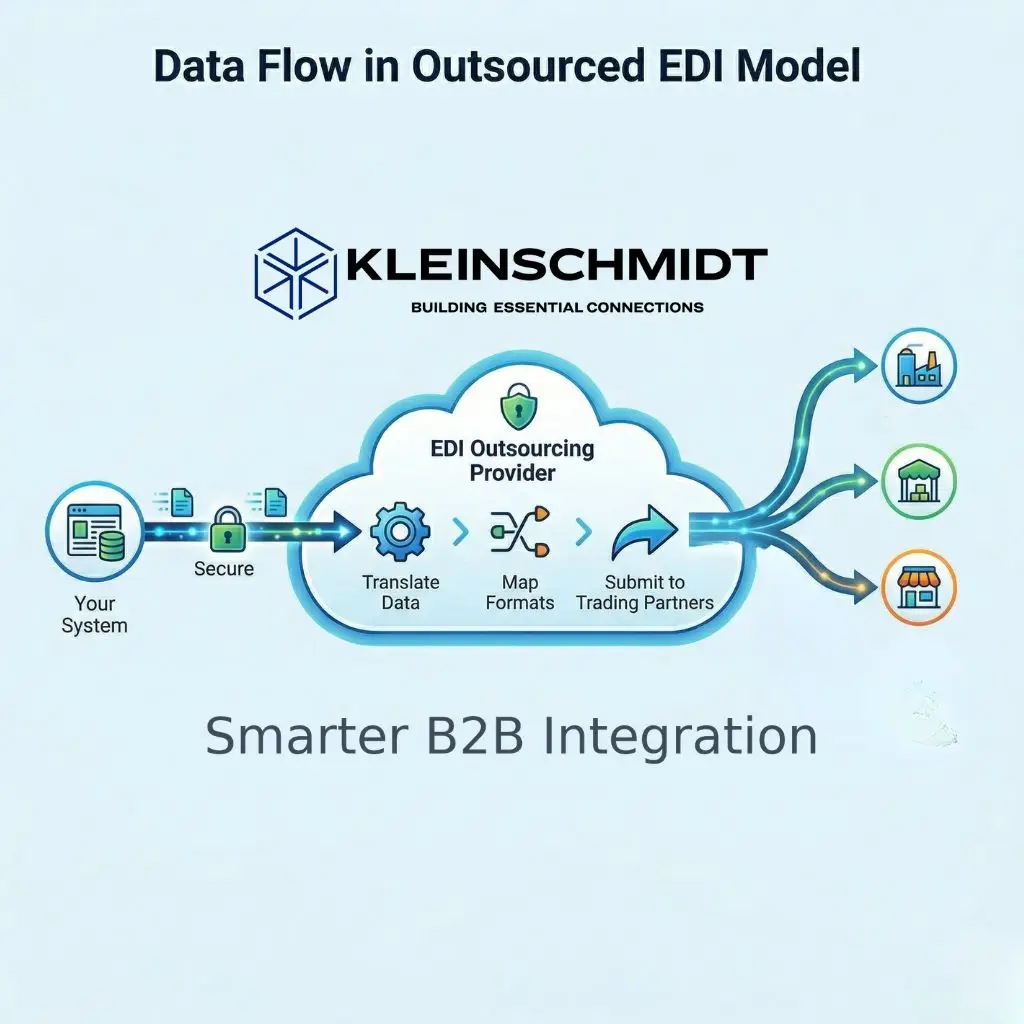
We act as a secure, SOC 2-compliant “universal translator” for your data. Our step-by-step process includes:
Secure Transfer: We securely send and receive your critical business data through SOC 2 compliant networking. We seamlessly handle the complexity of the varied protocols required by each of your trading partners, whether it’s AS2, SFTP, HTTPS, or something else.
Normalization & Mapping: We send and receive numerous data formats—from ANSI X12 and EDIFACT to XML and JSON—whatever can be dreamed up, we have processes in place. For example, a trucking company may use a cloud-based TMS that sends and receives JSON, but their shippers might use XML or X12. Our service includes translation on the fly so that each business can send and receive what they need, and the transformation that happened behind the scenes is undetectable.
Validation: We check the data against your partner’s specific rules before it delivers, protecting your margins from costly chargebacks.
24/7/365 Monitoring: We monitor your data 24/7/365 with on-premises data experts in our Chicago-area office. If you have any questions, you have a direct line to a real expert—no automated messaging, no chatbots.
The End Goal: Operational Efficiency without a Headache
Building, scaling, and maintaining a B2B network shouldn’t mean spending all your time troubleshooting manual connections or updating certificates. By moving to a managed EDI framework, IT teams can finally stop dealing with the “invisible” maintenance and technical friction that causes delays. This turns your data exchange into a reliable utility, letting the whole company focus on growing instead of getting bogged down in the technical details.
Building a team, buying software, and the hardware/environment is expensive to start up, maintain, and manage. Outsourced EDI gives you access to a larger pool of experts and a robust infrastructure at a predictable cost.
Yes. We are system-agnostic and integrate with any ERP (SAP, Oracle, NetSuite), TMS, or WMS.
Because we have thousands of pre-existing connections, you can often get your primary partners live in just a few weeks.
There is no charge to add a new trading partner. The only charge would be if there is custom programming involved.
24x7x365 support from our Chicago-area headquarters is provided to all customers without an additional contract.